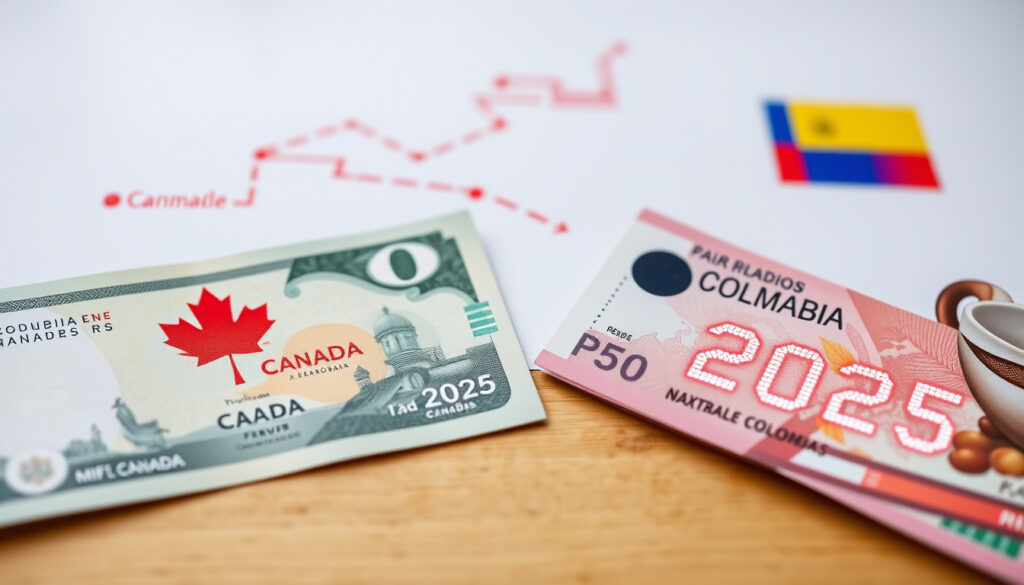
Canadian Dollar to Colombian Peso: 2025 Exchange Guide
You’ve probably daydreamed about Colombia’s coffee regions, Caribbean beaches, or the vibrant streets of Bogotá before you checked the exchange rate. That moment when you realize your Canadian dollar stretches further than back home — 2025 numbers show a mid-market rate of roughly 2,692 COP per CAD, meaning a $100 bill becomes a 269,000-peso wallet.
Current mid-market rate (1 CAD to COP): 2,692.09 · 30-day average: 2,641.92 · 30-day low: 2,598.68 · 30-day high: 2,734.61 · Cost of living index Colombia vs Canada: 60% lower · Minimum wage Colombia (monthly): 1,300,000 COP
Quick snapshot
- ≈ 269,209 COP
- Buys a week of groceries for one person
- Covers 2–3 meals at mid-range restaurants
- ≈ 807,627 COP
- Covers one month rent in a shared apartment
- Enough for a domestic flight within Colombia
- ≈ 2,692,090 COP
- Comfortable monthly budget for a single expat
- Covers rent, utilities, food, and transportation
- ≈ 134,604 COP
- A nice dinner out including drinks
- Day trip to a nearby town
Six key numbers that define the CAD-to-COP relationship right now, from the official mid-market range to the real-world cost gap between the two countries.
| Metric | Value |
|---|---|
| Current rate | 1 CAD = 2,692.09 COP |
| 30-day average | 2,641.92 |
| 30-day high | 2,734.61 |
| 30-day low | 2,598.68 |
| Colombia minimum wage (monthly) | 1,300,000 COP |
| Cost of living difference (Colombia vs Canada) | ≈ 60% lower |
How much is $100 Canadian in Colombian pesos?
Current exchange rate for 100 CAD
At the latest mid-market rate sourced from Xe.com (foreign exchange rate authority), 100 Canadian dollars equals about 269,209 Colombian pesos. That figure uses the base of 1 CAD = 2,692.09 COP, though the rate you get from a bank or transfer service will differ — often by 2–5% due to fees and spreads. Revolut (digital banking platform) showed a slightly different mid-point of roughly 2,909 COP per CAD in recent weeks, illustrating why shopping around matters.
How to calculate manually
- Take the amount in CAD and multiply by the exchange rate. For 100 CAD: 100 × 2,692.09 = 269,209 COP.
- For bank transfers, subtract the transfer fee and then apply the bank’s rate. Most Colombian banks add 0.5–1.5% on top of the mid-market rate.
- Example: a $100 transfer via a major Canadian bank might yield 263,000–267,000 COP after fees.
The mid-market rate is the fairest benchmark, but the average traveler loses about 3% per transaction. That’s roughly 8,000 COP on a $100 conversion — enough for a coffee and a pastry in Bogotá.
Is $50 a lot in Colombia?
What $50 can buy in Bogotá
Fifty Canadian dollars converts to roughly 134,600 COP at current rates. That peso amount can cover a three-course meal for two at a mid-range restaurant (around 80,000–100,000 COP), plus a taxi ride home. Numbeo (cost of living database) reports that a meal at an inexpensive restaurant in Bogotá averages about 25,000 COP, and a cappuccino costs roughly 8,000 COP.
Comparison to local income levels
- Colombia’s monthly minimum wage is 1,300,000 COP (Exchange-Rates.org (currency data provider)).
- $50 CAD equals about 10% of the monthly minimum wage — a meaningful amount for day-to-day living.
- For a Canadian tourist, $50 is a comfortable daily spending budget that covers meals, local transport, and a small souvenir.
Can you live on $1000 a month in Colombia?
Rent and utilities
One thousand Canadian dollars equals about 2,692,090 COP. According to Numbeo (cost of living database), a one-bedroom apartment in Bogotá’s city center rents for 1,200,000–1,800,000 COP per month — leaving 900,000–1,500,000 COP for utilities, food, and transport. Utilities (electricity, water, internet) run about 250,000 COP.
Groceries and transportation
- Groceries for one person: roughly 400,000–500,000 COP per month (local markets cost less).
- Public transit monthly pass: 100,000–150,000 COP.
- A budget of 2–3 million COP is considered comfortable for a single person living outside the most expensive neighborhoods.
Healthcare
Colombia’s public health system (EPS) costs about 200,000–300,000 COP per month for a foreign resident. Private health insurance is more expensive but still far below Canadian rates. Many expats report total monthly expenses of 2.5–3.5 million COP inclusive of rent, food, transport, and insurance — well within the $1,000 CAD range.
For a Canadian retiree or remote worker, $1,000 CAD a month offers a modest but comfortable lifestyle in a mid-sized Colombian city like Medellín or Bucaramanga. In Bogotá’s prime neighborhoods, that same budget would require roommates or trade-offs on dining out.
How much can 1 dollar buy in Colombia?
Cost of basic items in COP
One Canadian dollar buys about 2,692 COP. That single peso amount can purchase small daily essentials. According to Numbeo (cost of living database), a loaf of bread costs around 8,000 COP, a bottle of water 2,500 COP, and a local bus ride 2,000–3,000 COP. So your $1 CAD covers around one-third of a loaf of bread or one bottle of water.
Exchange rate impact on daily purchases
- A cup of coffee: 8,000 COP ≈ $3 CAD. That’s more than a Canadian coffee but affordable locally.
- A public bus fare: 2,500 COP ≈ $0.93 CAD.
- A mango or two from a street vendor: 3,000–5,000 COP ≈ $1.10–$1.85 CAD.
The direct conversion shows that most daily necessities are cheaper in Colombia, but imported goods and electronics are closer to Canadian prices because of tariffs and shipping costs.
What factors influence the CAD to COP exchange rate?
Commodity prices (oil)
Both Canada and Colombia are major oil exporters. When crude prices rise, both currencies tend to strengthen — but the CAD/COP pair is especially sensitive. Pound Sterling Live (financial data publication) recorded that the highest CAD/COP point in 2025 was 3,151.42 on April 9, coinciding with a spike in oil benchmarks. Conversely, during the September–November sell-off, oil fell and CAD/COP dropped.
Interest rate differences
The Bank of Canada and Banco de la República (Colombia’s central bank) set benchmark rates that influence capital flows. A higher rate in Canada attracts investment into CAD-denominated assets, pushing the CAD higher against COP. The gap between the two rates narrowed in 2025, contributing to the CAD’s 10.86% decline against the COP over the year (Exchange-Rates.org (currency data provider)).
Political stability
Colombia’s currency is more sensitive to domestic political events than Canada’s. Peace process updates, election cycles, and policy shifts (e.g., mining reforms) can cause short-term volatility. ExchangeRates.org.uk (foreign exchange tracking site) noted that on December 14, 2025, the rate stood at 2,764 COP per CAD — a level influenced by year-end repatriation flows and political calm after government announcements.
Oil and interest rates drive the long-term trend; political news creates short-term spikes. For anyone converting CAD to COP, the biggest risk is timing a transfer during a geopolitical shock that could shave 5–10% off the peso value overnight.
Cost of Living: Canada vs Colombia (Selected Cities)
Seven expense categories, one clear pattern: Colombia consistently costs 50–70% less than Canada for daily living, with rent being the biggest gap.
| Expense Category | Toronto (CAD) | Bogotá (COP converted to CAD) | Difference |
|---|---|---|---|
| One-bedroom apartment (city centre) | $2,200 | $1,200 (3,230,000 COP) | -45% |
| One-bedroom apartment (outside centre) | $1,650 | $700 (1,884,000 COP) | -58% |
| Monthly utilities (electricity, water, internet) | $200 | $93 (250,000 COP) | -54% |
| Public transport monthly pass | $156 | $46 (125,000 COP) | -71% |
| Meal at an inexpensive restaurant | $20 | $9 (25,000 COP) | -55% |
| Domestic beer (0.5L) | $3.25 | $1.30 (3,500 COP) | -60% |
| Cappuccino | $4.50 | $3 (8,000 COP) | -33% |
Source: Numbeo (cost of living database), January 2026.
The implication: the gap narrows for discretionary items like cappuccino, but big-ticket costs like rent still tilt heavily in Colombia’s favor.
How to Convert CAD to COP: Step-by-Step Guide
- Check the mid-market rate. Use Xe.com (foreign exchange rate authority) to get the real base rate.
- Compare transfer providers. Banks, Wise, Revolut, and local exchange offices each offer different rates and fees. Revolut (digital banking platform) often publishes competitive interbank rates for digital transfers.
- Factor in fees. Canadian bank wire transfers cost $10–$40; Colombian bank receipt fees can be 0.5–1% of the amount.
- Lock in the rate if you can. Some services let you set a target rate; if CAD/COP reaches it, the transfer executes automatically.
- Consider cash for small amounts. For trips under $500 CAD, using an ATM in Colombia (choose a bank that refunds fees) often beats the total cost of a wire transfer. Pound Sterling Live (financial data publication) notes that cash rates on the street sometimes add a 2–3% premium.
- Track the transfer. Most providers give a tracking code; confirm receipt in COP within 1–3 business days.
What’s Confirmed and What’s Unclear
Confirmed facts
- Exchange rates are volatile and change minute by minute.
- Mid-market rate is the fairest reference rate.
- Cost of living in Colombia is significantly lower than in Canada.
- In 2025, the CAD/COP rate reached a high of 3,151.42 on April 9 and a low of 2,630.23 on November 20 (Pound Sterling Live (financial data publication)).
What’s unclear
- Future direction depends on commodity prices, central bank policies, and global economic conditions.
- Exact cost of living varies by city and lifestyle — Bogotá is more expensive than small towns.
- Forecasts for 2026: CoinCodex (forex forecasting service) estimates an average of 2,779.99 COP per CAD, but with a wide range between 2,640 and 2,954 — meaning the market expects continued volatility.
What Experts and Expats Say
“With $1,000 CAD a month, you can live comfortably in Medellín or Bogotá, but you won’t be saving much.”
— Colombian expat blogger
“The COP is influenced by oil prices and the US dollar, making it sensitive to global market shifts.”
— Economist at Banco de la República
“I track the CAD/COP rate every morning. If it hits 2,720, I send money home. If it’s below 2,680, I wait. The difference on $2,000 CAD is about $80 CAD — that’s a nice dinner.”
— Canadian remote worker living in Colombia
For Canadian travelers planning a trip to Colombia, the choice is clear: use a low-fee digital transfer for amounts over $500, and withdraw small sums from ATMs in Colombian cities to avoid the worst exchange office spreads. If you’re also tracking precious metals, our Silver Spot Price Canada: Live CAD Rates & Forecast report complements this guide by showing how the same CAD strength affects silver buying power.
For a deeper look at how far your money goes on the ground, check out this guide on Colombian peso to CAD rates and real Colombia costs.
Frequently Asked Questions
Is it better to exchange CAD in Canada or Colombia?
Generally, exchanging in Colombia gives you a better rate because competition among exchange offices is high. Canadian airport kiosks and banks add 5–8% margin. In Bogotá, many cambio offices on the Carrera 7 corridor offer rates within 1% of the mid-market.
Do Colombian exchange offices accept Canadian dollars?
Yes, all major exchange houses in Colombian cities accept CAD. Some may offer a slightly lower rate for CAD than for USD, but it’s still a viable option. Check the rate before handing over cash.
What is the best time to convert CAD to COP?
Historically, the CAD weakens against the COP during the first half of the year and strengthens from October to December. Watching oil price trends and central bank rate decisions can help you time a large transfer.
Are there ATMs in Colombia that dispense COP with no fee?
Some Colombian banks (e.g., Davivienda, Bancolombia) charge no fee for foreign card withdrawals, but your Canadian bank may impose a fee of $3–$5 per transaction. Use ATMs inside bank branches for security.
How does the CAD to COP rate compare to the black market rate?
The black market (parallel) rate in Colombia often trades 1–3% above the official mid-market rate, especially at border areas. Using it carries legal and security risks; official rates from established financial institutions are preferable.
Can I use Canadian debit cards in Colombia?
Yes, most Colombian merchants accept Visa and Mastercard debit. Some small shops and markets prefer cash. Inform your bank before travel to avoid card blocks.
What is the typical fee for converting CAD to COP at a bank?
Canadian banks typically charge a 2–3% foreign exchange fee plus a wire transfer fee of $20–$40. Colombian banks receiving the wire may deduct 0.5–1% for processing. Digital services like Wise charge about 0.5% total.
How much cash should I bring to Colombia for a two-week trip?
A comfortable budget of $500–$800 CAD (1.3–2.1 million COP) should cover accommodation in mid-range hostels or Airbnb, meals, local transport, and a few excursions. Major credit cards are widely accepted in Bogotá and Medellín.
Convert US to CAD: Free Online Calculator & Live Rates — a companion tool for anyone managing multiple currency conversions.
More related posts
 French to English Translate – Best Tools Compared 2025
 37 USD to CAD Exchange Rate: Live Converter Shows 50.50 CAD
 Google Translate English to Spanish: Free Guide & Tips
 JOIA Paraiso by Iberostar: Riviera Maya Adults-Only Resort
 Lululemon We Made Too Much Canada – Official Clearance Guide
 What Is the Mediterranean Diet – Food List, Meal Plans & Recipes
 Bangladesh vs Sri Lanka 1st Test Scorecard 2025 – Full Details
 The Last Dinner Party: LGBT Identity and Why They’re Popular