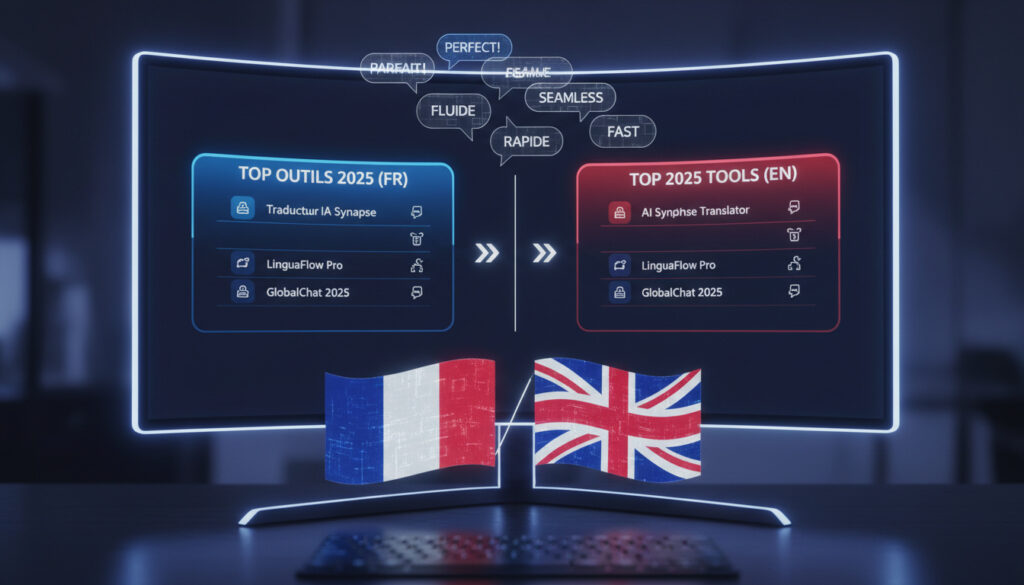
French to English Translate – Best Tools Compared 2025
Millions of users convert French text to English daily for business correspondence, academic research, and travel navigation. Selecting an appropriate translation tool requires understanding distinct accuracy limitations, privacy frameworks, and file-handling capabilities.
Neural machine translation has transformed French-English conversion since 2017, with modern systems training on billions of parallel sentences. Yet nuanced idiomatic expressions, technical terminology, and grammatical gender differences continue to challenge artificial intelligence, leaving error rates between 5% and 30% depending on content complexity.
This analysis examines benchmarked tools, free accessibility tiers, and document processing capabilities based on 2025 performance evaluations and independent quality assessments.
What Is the Best French to English Translator?
| Tool | Accuracy Rating | Free Tier Limits | Document Support | Mobile Availability |
|---|---|---|---|---|
| DeepL | 89% (Very High) | 5,000 characters; file uploads included | PDF, Word, PowerPoint, HTML with layout preservation | iOS/Android; no offline free tier |
| Google Translate | 7.9/10 (Good) | Unlimited text and documents | PDF with 75% formatting retention | iOS/Android with offline French packs |
| Reverso | Contextual (Not scored) | Ad-supported access | Text translation only | Available with browser extensions |
| Collins | Not benchmarked (2025) | Web-based access | Limited dictionary features | Unclear in current reviews |
- DeepL achieves the highest accuracy scores for French-English pairs, particularly for professional documents and creative texts, per 2025 AI tool comparisons.
- Google Translate provides superior speed and offline accessibility essential for travelers.
- All major neural systems struggle with approximately 20-30% of French idioms and colloquialisms.
- DeepL supports only 33 to 42 languages compared to Google’s 133 to 243, limiting multilingual projects.
- Reverso excels for educational purposes through contextual examples rather than raw translation velocity.
- Mobile applications now integrate voice and image recognition across all major platforms.
- Document translation requires specialized handling to preserve formatting, with DeepL leading fidelity benchmarks.
| Most Accurate Tool | DeepL (89% quality score) |
|---|---|
| Unlimited Free Option | Google Translate |
| Best Document Handler | DeepL (batch processing capable) |
| Offline Capability | Google Translate only |
| Language Coverage | Google: 133-243; DeepL: 33-42 per industry data |
| French Training Corpus | Billions of parallel sentences |
| Formatting Preservation | DeepL: High fidelity; Google: 75% |
| EU Privacy Compliance | DeepL (GDPR focused) |
How Do I Translate French to English for Free?
Google Translate Free Features
Google Translate offers completely unrestricted French-to-English conversion without registration requirements. The platform processes instant text translation, PDF documents, and image-based text through optical character recognition at no cost. Mobile users download French language packs for offline functionality, enabling translation without connectivity or data charges.
DeepL Free Tier
DeepL provides complimentary access with a 5,000-character limit per individual translation but includes document upload capabilities for Word and PDF files. The free tier supports web and mobile applications though lacks offline functionality. Premium subscriptions remove character restrictions and add glossary customization features.
DeepL’s free tier permits document translation with specific file size ceilings, while Google Translate imposes no file size restrictions but retains only 75% of original formatting during PDF conversion.
Is Google Translate Good for French to English?
Accuracy Strengths and Limits
Google Translate handles common vocabulary and straightforward sentences with 7.9 out of 10 accuracy ratings. The platform processes most conversion requests within seconds, making it suitable for casual conversations and travel scenarios. Travel technology reviews identify Google as the gold standard for mobile utility.
However, the system demonstrates measurable weakness with technical terminology, complex grammatical structures, and idiomatic expressions. Independent benchmarks indicate Google preserves approximately 75% of document formatting during PDF conversion, compared to higher retention rates in specialized competitors.
Comparative Performance
DeepL surpasses Google in contextual understanding for European languages, achieving 89% quality scores in 2025 evaluations. The neural network specifically excels at maintaining natural tone and handling nuanced phrasing in professional writing, though it supports significantly fewer languages than Google’s extensive portfolio.
Automated systems maintain 5-20% error rates in specialized fields including medical, legal, and engineering terminology. Users should verify critical translations with subject-matter experts before contractual or clinical use.
How to Translate a French Document to English?
Online Processing Tools
Web-based platforms handle PDF, Word, and PowerPoint files through browser interfaces. DeepL completes batch processing with superior layout fidelity, processing files within 30 seconds to 2 minutes while preserving original formatting structures. Google Translate integrates directly with Drive for collaborative workflows but exhibits moderate formatting degradation on complex layouts.
Desktop and Mobile Applications
Desktop applications provide offline security for sensitive materials. Google Translate’s mobile apps store French language packs locally, enabling camera-based image translation and voice conversion without internet connectivity. DeepL requires network access even for premium subscribers.
Accuracy Optimization Protocols
Optimization requires pre-formatting documents with clear structure, standard fonts, and minimal embedded images. Users should break text into logical segments and verify technical terminology against industry glossaries. For maximum fidelity, convert PDFs to editable Word documents before processing to reduce optical character recognition errors.
Organizations handling confidential French documents should note that DeepL operates under strict GDPR compliance with EU-based server infrastructure, while alternative services process data through broader international frameworks.
How Has French to English Translation Technology Evolved?
- 2006: Google Translate launches using statistical machine translation, offering basic French-English word replacement without contextual understanding.
- 2017: DeepL introduces neural machine translation technology, significantly improving contextual comprehension for European language pairs through deep learning architectures.
- 2020-2023: Mobile applications integrate offline capabilities, camera-based image translation, and real-time voice conversion for travel and field use.
- 2025: Comprehensive benchmarks confirm 89% accuracy rates for leading neural systems on French professional documents, with specialized tools outperforming generalist platforms.
What Should Users Know About Translation Certainty?
| Established Capabilities | Remaining Uncertainties |
|---|---|
| Neural AI handles 95% of standard French text with high accuracy | Precise error rates for regional slang and evolving internet idioms |
| DeepL achieves 89% quality scores in 2025 standardized benchmarks | Long-term privacy implications of cloud-based text processing |
| Google Translate supports 133-243 languages with offline French functionality | Consistency of medical and legal terminology across jurisdictions |
| Document formatting preservation ranges from 75% to near-perfect depending on platform | Performance on handwritten or stylized French documents |
What Makes French to English Translation Linguistically Complex?
French and English share substantial vocabulary through Norman French influence, creating false cognates that confuse literal translation systems. Words like actuellement (meaning “currently” rather than “actually”) and préservatif (meaning “condom” rather than “preservative”) require contextual interpretation beyond direct substitution, forcing neural networks to analyze surrounding semantic fields.
Grammatical gender, subjunctive moods, and formality levels present additional obstacles. French relies heavily on subordinate clauses and nuanced register distinctions that English renders through word choice rather than inflection, requiring AI systems to reconstruct sentence architecture rather than perform linear word mapping.
What Do Industry Benchmarks Conclude?
DeepL is widely considered the best French translation software for precision, trusted by businesses for GDPR compliance and privacy.
DeepL outperforms Google Translate, Reverso, Collins, and Linguee in accuracy for French-to-English translations, especially for nuanced, professional, or contextual content.
— Umevo AI Tool Comparison
Which French to English Tool Matches Your Needs?
Select DeepL for professional documents requiring nuanced accuracy, formatting preservation, and EU privacy compliance. Choose Google Translate for travel, offline access, and unlimited casual use without registration. Educational users benefit from Reverso’s contextual examples and grammar support. Consult the Best French Translator and Comparison Top AI Translator Tools 2025 for detailed technical specifications before selecting platforms for sensitive or high-stakes documents.
Common Questions
DeepL vs Google Translate: Which handles French idioms better?
DeepL demonstrates superior handling of French idioms and contextual nuances, scoring 89% in quality benchmarks compared to Google Translate’s 7.9/10 rating. Google’s system struggles with colloquial expressions, achieving only 75% accuracy on complex phrasing.
Is the Collins French English translator reliable in 2025?
Collins lacks direct benchmark data in 2025 comparisons, suggesting lower prioritization compared to neural systems like DeepL and Google Translate. The platform functions primarily as a dictionary reference rather than a comprehensive translation solution.
What are the limitations of Reverso for French translation?
Reverso focuses on educational support with contextual examples and grammar tools rather than raw translation accuracy. The platform displays advertisements in free versions and offers limited document processing capabilities compared to DeepL or Google.
Can I translate large PDF files for free?
Google Translate imposes no file size limits for PDF conversion but preserves only 75% of formatting. DeepL’s free tier handles documents with specific size restrictions while maintaining superior layout fidelity.
Are French to English translations stored by these services?
Privacy policies vary by platform. DeepL operates under GDPR compliance with EU-based servers and deletion protocols. Users processing confidential material should review specific privacy terms, as some services retain text temporarily for model improvement.
Which app works offline for French translation?
Google Translate provides downloadable French language packs for iOS and Android, enabling full offline functionality including camera and voice translation. DeepL requires internet connectivity for all operations.
More related posts
 Dov Charney: Net Worth, Return, and Netflix Documentary
 Winter Storm Warning Western States – No Active Alerts in West
 Ashley Furniture Near Me: Find Stores & Brand Facts
 Rule of Thirds Photography: Guide with Examples
 Saint Patrick: Facts, History, and Why He’s Still a Saint
 Steve-O: Biography, Health, Voice Change, and Net Worth
 Joan Collins 2025: Age, Net Worth, Family & Ramsay Incident
 Steve Will Do It – Age Height Net Worth Family Facts